
“Tell me and I forget.
Teach me and I remember.
Involve me and I learn.”
Your rock star took every class you offered. Here's what she still needs.
You promoted your rock star.
She went from individual contributor to team lead to manager. Great news. She's excited and ready to go.
She knows the technical side of the job cold. And she got lucky. Your organization offers leadership development classes a few times a year, and she took full advantage. She showed up, leaned in, and had more than a few aha moments along the way.
Now let's fast forward eight or ten months.
How's she doing?
More importantly, would she give you the same answer you'd give?
Her inbox is full. Her calendar is back-to-back meetings. She's got a problem team member, deadlines are piling up, and she's more than a little overwhelmed.
But she's a rock star, so it isn't showing as much as you'd think. Calm on the surface. Feet going a million miles a minute underneath.
So here's the real question. Is she using the tools from those leadership classes? Or is she blowing right past them like the Road Runner with Wile E. Coyote somewhere in the dust behind her?
The good news is there's an answer, and it's not complicated. Give her the support she needs.
Sure, you could meet with her more often. Then you look at your own calendar. It's not that you don't want to. You're just not sure you can keep it up consistently.
Which leads to the question worth asking. Is she struggling because she didn't learn the skills? Or because she hasn't had enough opportunity and support to put them into practice?
The Gap Between Knowing and Doing
Learning a leadership skill and using it consistently are two very different things.
After 30 years in learning and development and coaching, there's one question I keep coming back to. When the training is over, what happens next?
The leftover sandwiches go to the break room. Everyone heads back to their desk to dig out from the emails and Slack messages they missed.
And then what?
In the workshop, they learned how to delegate, give feedback, manage conflict, and set clear expectations.
Back at the office, things look a little different.
That accountability conversation isn't a role-play anymore. It's with someone she's worked alongside for five years.
Delegation isn't an exercise. It's handing over something she's convinced nobody else can do as well as she can.
And feedback is a lot harder when the person across the table gets defensive.
So when does the real practice happen?
Don't get me wrong. Workshops matter. They're critical, in fact. And yes, good ones build in practice time. But you know how role-plays go. They can be helpful, but it's a controlled environment. Nobody's real career or real feelings are on the line.
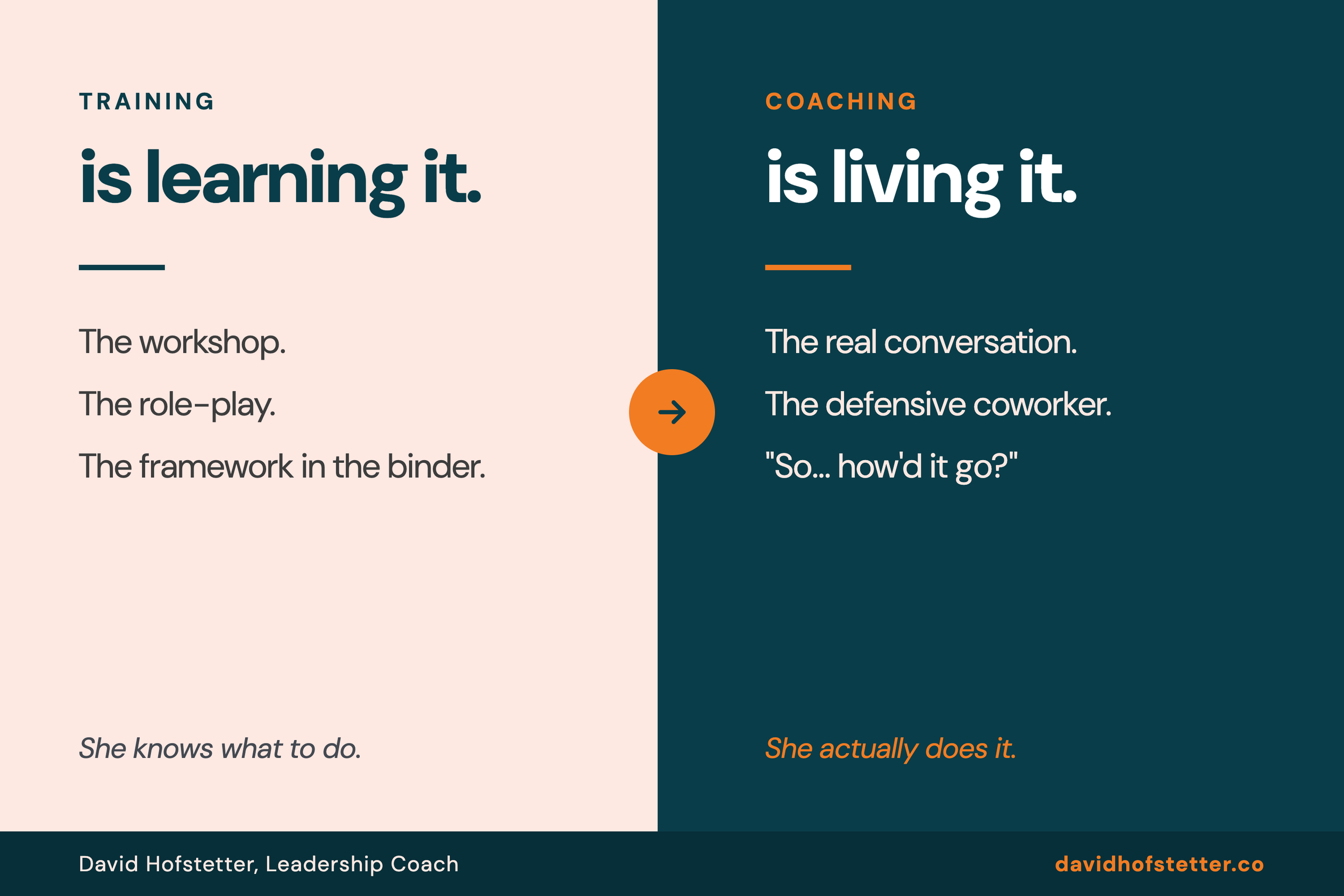
The real application happens back on the job. That's where coaching comes in.
Learning and coaching are two sides of the same coin. Yin and yang. You need both.
What Happens Without Ongoing Development?
I'm not going to walk through everything that can go wrong. You've probably seen most of it. Here are the big three.
She goes back to what she knows.
When the pressure's on, she falls back on what made her successful as an individual contributor. She solves the problem herself instead of developing her team.
That's human. We all slide back into our comfort zone when stress goes up.
Then the pressure lets up, she finally has a minute to think about how it went, and the guilt kicks in. She knows what she should have done. And she's really good at beating herself up for not doing it.
Small problems become big ones.
She avoids a difficult conversation because she isn't sure how to approach it. Three months later, the problem is a lot worse.
Avoidance is one of the places a coach makes the biggest difference. Through good questions and a little practice, a coach can nudge her out of her comfort zone, build her confidence, get her to try something new, and then talk through how it went without judgment.
Lessons learned. Next time goes better.
Her confidence starts to slip.
Quietly, she starts wondering whether she's cut out for management at all.
And there's a cost to the organization, too.
You invested in developing a promising employee. Then you didn't give her enough support to actually succeed in the role.
Organizations spend a lot of time preparing people to become managers. How much time do they spend supporting them once they're in the job?
That looks different everywhere. Some organizations have a real management onboarding program. Others hand over the title, wish her luck, and say something like, "Come see me if you have any questions."
Either way, coaching can bridge the gap. It connects the leadership development she already got, the support she needs in the new role, and any onboarding program you already have in place.
Development Doesn't End When the Workshop Does
So if the workshop isn't the finish line, what should development look like after it?
After 30 years of watching this play out, I think it comes down to four things.
Practice until it becomes a habit
Nobody remembers everything from a workshop. I've run hundreds of them, and trust me, they don't.
That's fine. That was never the point.
The point is to take one or two things and practice them until they stop feeling like something she learned and start feeling like how she leads.
That takes reps. And reps take time, which a two-day program just doesn't have.
Work on the problem that's actually in front of her
This is where development gets personal.
One manager is struggling to delegate. Another is avoiding a conversation she's been rehearsing in the shower for three weeks. A third is trying to manage the people she used to go to lunch with.
They don't need another class that covers all three.
They need help with the one they're facing this week.
Get honest about how she's showing up
Every manager has blind spots. Every manager has strengths she undersells. Most have never been asked to look closely at either.
I want to be careful here, because this is usually where someone starts talking about "fixing weaknesses." That's not it. Coaching isn't remedial.
It's about helping her see how her behavior lands with other people, then making choices on purpose instead of on autopilot. That's how she builds a leadership style that actually feels like her, not a copy of the last boss she had.
Somebody has to ask, "So... how'd it go?"
This is the one most organizations skip. And honestly, it might be the most important.
Managers leave workshops with every intention of doing things differently. I believe them. They mean it.
But intentions aren't behaviors.
Somebody has to follow up. What did you try? What happened? What would you do differently next time?
Without that conversation, the binder goes on the shelf and the old habits come back. Right on schedule.
That follow-up is where lasting development actually starts.
Coaching Is One Way to Bridge the Gap
Okay, I'm a coach. You probably saw this section coming.
But here's what might surprise you. Coaching doesn't always mean hiring someone like me.
There are a few good ways to keep development going after the training ends.
Her own manager can hold regular development conversations, giving feedback and helping her sort out priorities. A peer group gives her a place to compare notes with people who get it. A mentor can share the perspective of someone who's already walked this road. And a coach, one-on-one or in a group, can help her examine her own thinking, spot her blind spots, explore other options, and commit to doing something about it.
Each one does something different. None of them is wrong.
What matters isn't which one you pick. It's that development keeps going after the workshop ends.
One more distinction worth making. Coaching isn't advice-giving. A good coach isn't there to hand her the answers. The goal is to help her get better at finding those answers on her own, so she doesn't need me (or anyone else) in her ear forever.
That's what people-first leadership looks like. You develop your people so they can develop theirs.
What's in It for the Organization?
I'll keep this short. Nobody wants to read a brochure.
You get better leaders. Managers who can work through the hard stuff on their own make better decisions and need a lot less hand-holding. From you, specifically.
You get stronger teams. When a manager communicates clearly, gives real feedback, and actually develops her people, the whole team feels it.
And people stay. Supporting your managers keeps promising leaders from quietly updating their LinkedIn profiles, and it makes work better for everyone who reports to them.
Which brings me to the line I'd underline twice:
You're not investing in one manager. You're investing in everyone she leads.
Back to Your Rock Star
Remember her? Full inbox, back-to-back meetings, still smiling in the hallway?
She's still talented. She still has potential. Nothing about that has changed.
But potential alone was never going to be enough.
The question isn't whether she needs more leadership development. She does. We all do.
The question is whether she'll get the support to turn what she learned into how she leads.
You invested in helping her become a manager.
Don't stop investing now that she is one.
Your Turn
Reflect: Think about the managers in your organization. How much support do they actually get once a leadership program ends?
Assess: Are they using what they learned? Or sliding back into old habits the minute things get hard?
Engage: Pick one way to keep development going this month. A standing development conversation, a peer learning group, a mentor, or coaching. Start with one.
If coaching is the one you pick, let's talk.
