
Should I stay or go back to an Individual Contributor role?
The practice of management — part 3
In the last two posts, we talked about what really happens after a promotion, and why some managers make it while others don't. Today we're asking the question most managers are afraid to say out loud.
So you made it. You're managing your own team, the same people you had lunch with every day. (Okay, having lunch is more of a fantasy now than a reality.) You worked side by side with these people for years. You had the conversations. When I'm in charge, here's what I'll do differently.
And then it happened. Your boss left or moved up, and the job was yours. Which made complete sense, you were an outstanding team member. Strong emotional intelligence. Top-notch work. You knew how to motivate people. Your teammates were excited. Finally, someone who gets it.
Fast forward 8–12 months.
You're frustrated. You're stressed. You're just plain tired. You didn't know about all the behind-the-scenes work. You didn't know one of your team members wasn't quite as strong as you'd thought. You didn't know your new boss was a micromanager. And the "what I didn't know" list just keeps growing.
Your team doesn't think you're credible. It's spilling into your home life. You're exhausted. You're on your phone at 10pm trying to keep up. And somewhere in the back of your head, you hear it, that old Clash song (from Stranger Things song) asking the question you're too afraid to say at work:
🎶Should I stay or should I go?🎶
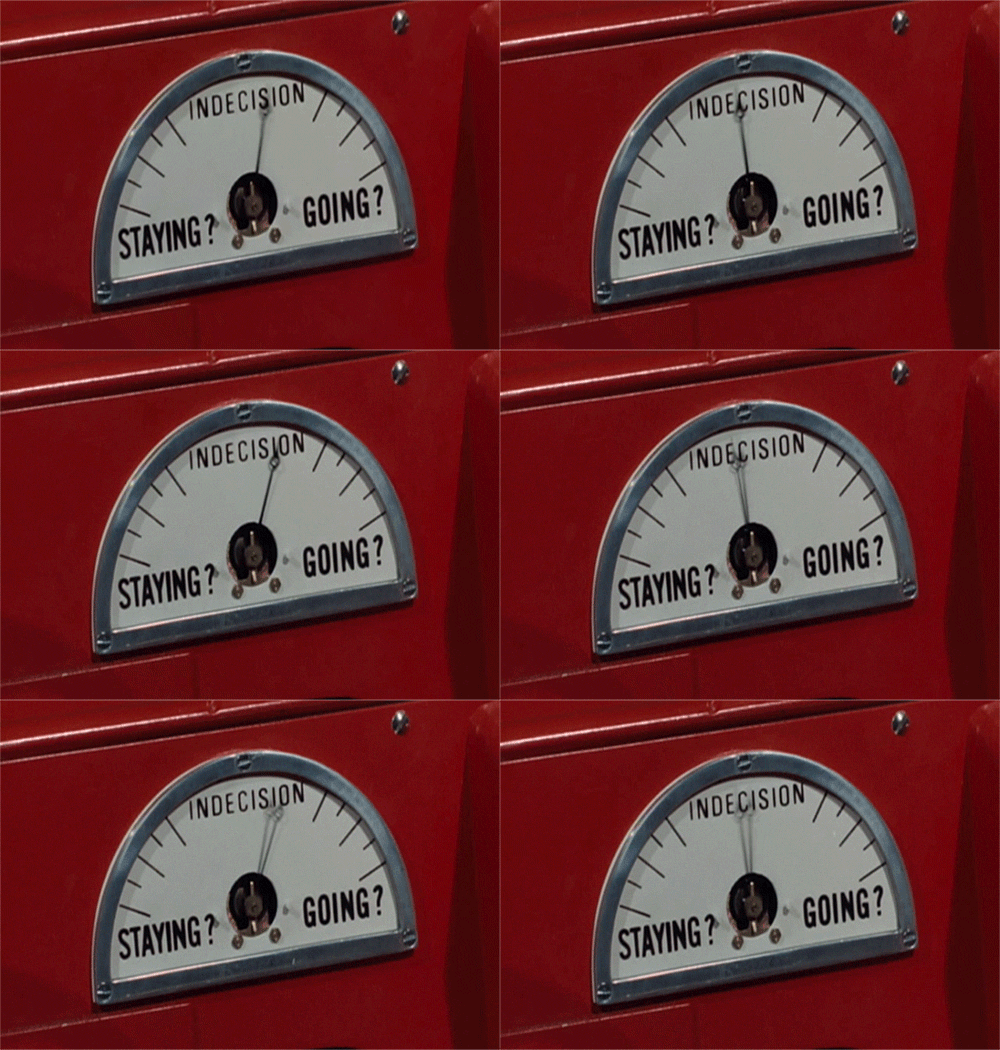
Here's what I want you to know first: you are not alone. A 2023 McKinsey & Company survey found that 34% of senior managers want to switch back to individual contributor roles.
Research from CCL and ATA Recruitment shows that 60% of first-time managers are deemed ineffective within 24 months.
Industry data suggests that more than half of new managers who took the role primarily for money or status end up regretting it, in large part because most received little to no management training before stepping in.
This is more common than anyone talks about. And it's worth having the honest conversation.
You actually have three choices
Most people in this situation only see two options, gut it out or quit. But there are really three, and the one most people skip over is worth a serious look.
1. Stay and master the role. Decide that this role is worth figuring out, and get the support to actually do it. A coach, a mentor, a trusted peer. The managers who turn it around almost never do it alone.
2. Ask to go back to an individual contributor role. More common than you think, and not the career death sentence most people fear. We'll get into this one.
3. Leave the company. Sometimes the right call, but make sure you're not just running from a problem that'll follow you to the next place.
Why going back isn't failure
Let's be honest about something. Many managers were promoted because they were exceptional individual contributors, not because they had management potential. That's not their fault. It's a structural problem organizations have been making for decades.
Here's what often drives the desire to go back:
Lack of training. You were great at your job, so they made you responsible for other people's jobs. Nobody taught you how.
Preference for the craft. Some people genuinely find more meaning in doing the work than in managing others who do it. That's not a character flaw — it's self-awareness.
Burnout. Management roles carry more stress, more ambiguity, and more hours — often with less visible output to show for it.
Misaligned motivation. If you took the role for the title or the salary bump — not because you genuinely wanted to lead people — you probably felt the gap early. And you're not alone in that.
None of these make you a bad person. They make you human.
Before you decide, ask yourself these questions
Going back to an IC role can absolutely be the right move. But it's worth slowing down before you do. A few honest questions:
Have you actually asked for help — a coach, a mentor, a trusted peer who has been where you are?
Is the problem the role itself, or the environment you're in?
Are you running from this job, or toward something that actually fits you better?
What did you love about being an IC, and is that fulfillment still available to you in some form where you are?
That first question matters more than people realize. Most managers who struggle are trying to figure it out alone, reading articles at midnight, white-knuckling through team meetings, hoping next quarter feels different. The ones who turn it around almost always had someone in their corner helping them see what they couldn't see themselves.
If you've genuinely given it a real shot, gotten support, built the skills, addressed the right things, and you're still miserable? Going back isn't retreating. It's choosing clarity over ego. And that takes more self-awareness than most people give it credit for.
The bottom line
Leadership isn't for everyone. That's not a failure, that's information. The managers who figure that out early and act on it honestly often end up being the most respected people in the room, in whatever role they're in.
The ones who gut it out indefinitely because they can't admit the truth? They burn out, their teams suffer, and everyone knows it.
Should you stay or should you go? Only you can answer that. But the fact that you're asking the question honestly puts you ahead of most people who never will.
Next week: If you decide to stay and master the role, there's one skill that separates the managers who turn it around from those who don't. Next week we're talking about coaching, how to develop yourself, develop your team, and finally start leading in a way that actually sticks.
