
Most managers assume they have trust.
They show up. They do the work. They care about their team. That should be enough, right?
Maybe. But "caring" and "trusted" aren't the same thing, and the gap between them is where a lot of newly promoted managers get stuck.
Here's how to know which side of that line you're on.
The Feeling You Can't Quite Name
You leave a team meeting and something feels off. Everyone said the right things, but it didn't quite add up.
You have a one-on-one and find out something's been going on for weeks. Nobody mentioned it. You're the last to know.
You walk out of a conversation with your boss with that nagging feeling, like you're only getting part of the picture.
And then you start doing that comparison in your head. My peers seem to get more candid conversations. Their teams are more open. More collaborative. Is it me?
That feeling is worth taking seriously.
What Low Trust Actually Looks Like
It's rarely dramatic. It doesn't look like conflict or confrontation.
It looks like this:
Silence or false agreement. Everyone nods. Nobody pushes back. Disagreement feels too risky, so the room just goes along.
Problems that appear fully formed. Your team doesn't bring you issues early — they wait until something is either completely resolved or completely on fire.
Only polished work. Nobody shows you the messy middle. You only see the finished product, never the struggle to get there.
Going around you. Decisions get made informally. People seek guidance from your boss or other departments instead of coming to you first.
Overly formal conversations. Everything is transactional. There's no casual back-and-forth, no vulnerability, nothing that feels like a real relationship.
None of this looks like a crisis from the outside. But underneath? Your team has quietly decided what's safe to tell you and what isn't.
Before You Try to Fix It — Figure Out If It's Real
Here's the thing: sometimes this is a trust problem. And sometimes it's a perception problem. Both are worth addressing, but they need different responses.
Take five minutes and answer these questions honestly:
Who is one person at work you genuinely have an open relationship with? What did you actually do to build that? How did it start?
When you look at a peer who seems to get more candid conversations than you, what do you notice about how they operate? Which of those feels like something you could authentically try, not just admire?
When's the last time someone brought you a problem before it became a crisis? If you can't remember, that's data.
This isn't a formal assessment. It's just a starting point. But it tells you whether you're dealing with a real gap or a confidence gap — and both have a different path forward.
How Trust Actually Gets Built
Here's what I see managers get wrong: they think trust is built in the big moments. The all-hands meeting. The big feedback conversation. The moment they stood up for someone.
Those matter. But they're not where trust lives day to day.
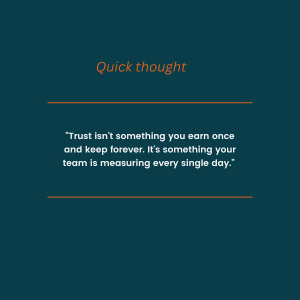
Trust is built in the ordinary moments, repeated consistently.
The follow-through after a meeting. Whether you said you'd get back to someone and actually did. How you reacted the last time someone brought you bad news. Whether you owned a mistake or quietly moved past it.
Your team is tracking all of that — not consciously, but they are. And the picture they've built over time determines how much they're willing to tell you.
A few things that move the needle:
Close the say-do gap. If you say you're going to do something, do it. Reliability is the foundation everything else sits on.
Share the "why." When decisions get made above you, tell your team what you can. Transparency builds more trust than silence, even when the news isn't great.
React well to bad news. If someone brings you a problem and you respond with frustration or blame, they'll remember. If you respond with curiosity and problem-solving, they'll remember that too.
Own your mistakes. This one's harder than it sounds. But a manager who says "I got that wrong" builds more credibility than one who never does.
Show personal interest. Know something about your team members beyond their job title. Ask. Remember. Follow up.
None of this is revolutionary. But doing it consistently, that's the job.
One Thing to Do This Week
Pick one person on your team where the relationship feels a little surface-level or transactional.
Have one conversation with them that isn't about the work.
Ask how something went for them — not the project, them. And actually wait for the answer.
That's it. Trust is rebuilt in the margins — in the moments that don't feel like leadership moves but absolutely are.
The Bottom Line
You don't have to be everyone's best friend to be a trusted manager. But you do have to be consistent, honest, and genuinely interested in the people on your team.
If something feels off, pay attention to it. Don't assume it'll work itself out.
The managers who build real trust aren't doing anything exotic. They're just doing the ordinary things, reliably — and they're paying attention when something feels off.
If you're navigating the trust and relationship side of management, especially if you're newly promoted and figuring out how to lead people who used to be your peers, that's exactly what I work on with clients.
Book a free discovery call atgo.davidhofstetter.co/call and let's talk.
